Thursday, October 17, 2013

30 Things You Should Know and/or Will Love about Japan Series: # 28

#28 Mochi

What is Mochi?
Image Credit: www.straberrysmochi.tumblr.com

Mochi is a rice cake made from pounding glutinous rice.  
Maybe this is still not clear if you've never seen it or tasted it.

I love it, but I don't think everyone likes it.  It's super gummy/chewy/elastic.

I've always heard of tales of people choking on it (like here and here), so little kids and the elderly (really everyone) should eat with care.  It can be served many ways, but of course, it is usually served beautifully.

My favorite way to eat mochi is sweet, around a strawberry covered in a layer of bean paste.

Image Credit: www.justonecookbook.com
Hopefully we can find these while you are here.  Strawberries are a winter fruit here, so we'll see.

It can be served savory too, like in okonomiyaki or in other dishes.

While it can be made manually like my students following the traditional way to pound mochi here:
Some students pounding rice to make mochi

It's just as easy to buy mochi powder at the store.  I have never attempted to make mochi on my own, because there are so many great places to buy mochi treats, but I think it's fairly easy.

Wagashi is the term for Japanese sweets, usually served during a Japanese tea ceremony.  It usually contains mochi and they are beautiful pieces of art.  There is so much information on wagashi and mochi, so investigate some more if you are interested.

Wednesday, October 16, 2013

30 Things You Should Know and/or Will Love about Japan Series: # 27

#27: Okonomiyaki
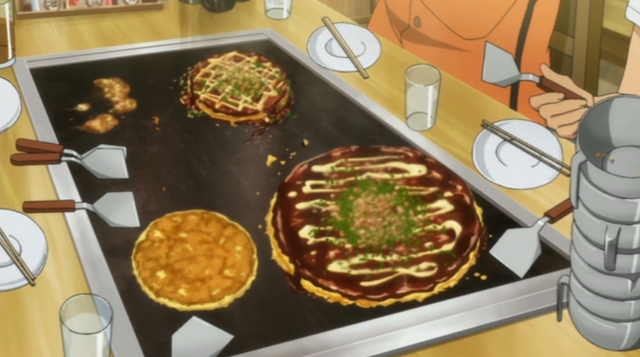
Image Credit: www.crunchyroll.com
As the weather starts to change this time of year, I start to crave more okonomiyaki.

Okonomiyaki is a savory thick pancake that can contain a variety of ingredients.  The most common is cabbage, egg, flour and some pork belly.  You can get a lot of variations of this, including the addition of noodles, shrimp, squid, mochi or even cheese.

One of my favorite places to get it from is the guy who has a stand out in front of Pantry (one of the grocery stores on island).  There are many okonomiyaki restaurants around Japan, some where you make your own and others where it is brought to you.

Okonomiyaki is mainly associated with the Kansai region (the area in which we live) and Hiroshima (where we will also travel).  In Kansai it is more of a mixed pancake while one in Hiroshima is more layered.

I always order it "nashi mayonnaise" (without mayo).  I love to watch the bonto flakes dance on top as it "melts' into the hot okonomiyaki.  I like the okonomiyaki sauce on it - it's hard to explain, but maybe a mix of Worcestire sauce/ Teriyaki sauce.  (That may be a stretch).

Image Credit: www.tofugu.com
Itadakimasu!  いただきます!
(Japanese version of Bon Appetit!)

Tuesday, October 15, 2013

30 Things You Should Know and/or Will Love about Japan Series: # 26

#26 Puppy Love

In Japan, people love their dogs.  For the most part, people live in small apartments, so most of the time these are very small dogs.  Most apartment complexes have rules on the size of the dog living in apartments, so you don't see large dogs frequently.

Dogs here are often dressed up.
Image Credit: www.tokyotimes.org

It's not uncommon to see a dog in a stroller.

It's not even that uncommon to see a dog in a "baby" sling.

There are many specialty shops for animal accessories, so one's dog can be as cute (kawaii!) as the owner.

This little pup is for sale in a tiny little dog boutique right near our house for about $3,000 USD
Japanese dog owners are very respectful when taking their dogs out.  They are often seen with a little bag which includes bags for poop and often a water bottle to rinse off any areas that the dogs may have peed.  It is very uncommon to see dog poop in parks, which is nice when you have little kids running through them.

Monday, October 14, 2013

30 Things You Should Know and/or Will Love about Japan Series: # 25

#25 - Sports Day


Sports Day is my favorite school day out of the whole year.  Sports Day is a national holiday in Japan.  This holiday began to commemorate the Tokyo Olympics in 1964 and it was created to promote health and well being.

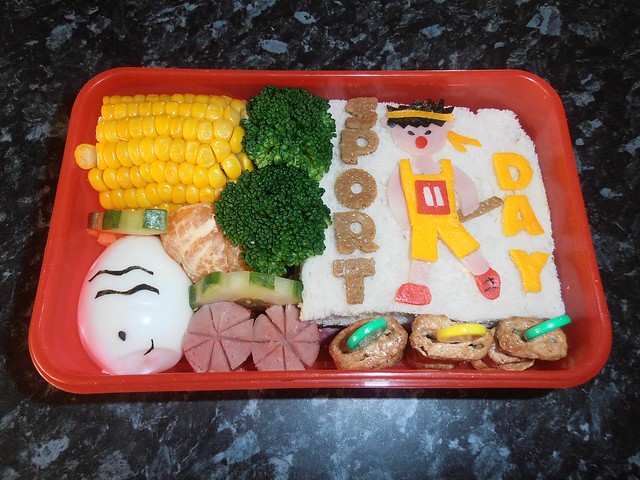
Schools have large events on these days which would compare to a Field Day in the U.S. (but better).  All families come to Sports Day.  Sports Day looks a little different at our school compared to Japanese schools.  Most of the Japanese schools on our island have already had their Sports Days the last two weekends.  In combination to a well orchestrated event and competitions, there is also an bento (lunch) "competition" amongst the moms.  A lot of time and effort goes into creating these beautiful and balanced lunches.


Our school has events that the whole school participates in (my favorites) and then the different sections of the schools go off and has competitions by grade level/age levels.  It isn't too competitive at our school, but the kids do separate off into two teams - Red and Gray, representing our school colors.

This year, our Sports Day is going to be a bit different, because it's our school's Centennial Celebration, so there are a lot of alumni and guests on campus.  We will only have the full school group activities and then a whole community BBQ.

Go Team Read 2012
Here are some of our previous Sports Day blogposts:
Sports Day 2009
Sports Day 2010 (no record of this - but I was VERY pregnant with Lola, so we'll blame her)
Sports Day 2011
Sports Day 2012

We're excited this year, because Lola will be joining us.  Her daycare is closed due the the national holiday and now that she's a bit older, she can come and hang out with us, and maybe even participate a bit!

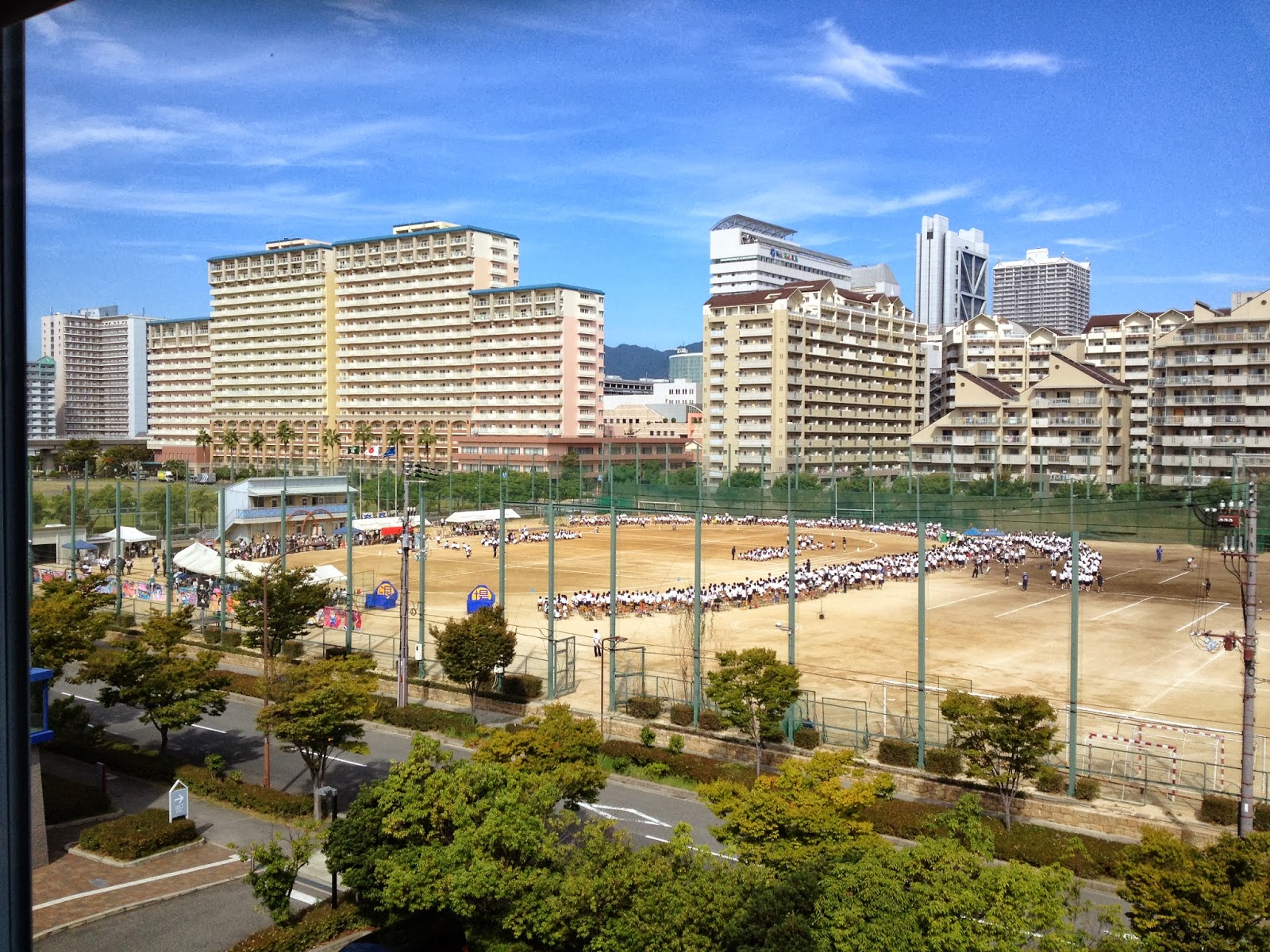
Sports Day at the Rokko Island High School last week


Sports Day 2013 Pictures HERE

Sunday, October 13, 2013

30 Things You Should Know and/or Will Love about Japan Series: # 22

#22 Money - Japanese Yen

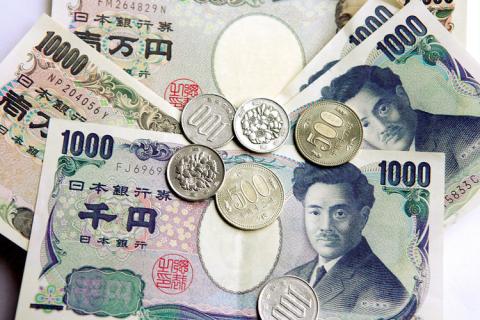
Image Credit: www.eftrends.com
In Japan, the currency is the yen noted as ¥ or 円.  At the time this is being published, the rate of the Yen to the U.S. dollar is about 100¥ to $1.  One of the easiest things to do (and something we did for the first few years we were here when taking money out of the ATM machines), is to just cover up the last two digits to figure out how much you are spending.  Seriously, those zeros sometimes get confusing.

Bills
The 1,000 Yen note is about $10 USD.
Image Credit: https://encrypted-tbn3.gstatic.com/
The 10,000 Yen note is about $100 USD.  And referred to as "an ichiman"
Image Credit: http://currencyguide.eu/
(There is also a 2000¥ note, but the aren't commonly found when you are out and about shopping for things).

Coins
Image Credit: http://www.gjsentinel.com
500¥ - about $5 USD (it's about the size of a silver dollar)
100¥ is about $1 USD
50¥ is about 50 cents
10¥ is about 10 cents
5 ¥ is about 5 cents
1 ¥ is just like our penny (and feels fake and almost weighs nothing).

In Japan, the money is always clean and barely looks used.

Foreign debit/credit cards in Japan usually work at the stores, but not always at the ATM machines, which are plentiful.  However, the Post Offices have ATMs that accept foreign cards (and have "English" and sometimes "Korean"/"Portuguese" buttons for easy use).

One of the other issues with getting cash, as at least where we live, is that there are no ATM machines open late at night or early in the morning - so you just have to plan well when you need cash.

When you are here, you'll have no issues, as we have both foreign and Japanese bank accounts to get money.

And always, because Japan is so safe, you can easily walk around with money or ask for help when you are trying to figure out how much something is, because they are definitely not trying to rip you off!

Wednesday, October 09, 2013

30 Things You Should Know and/or Will Love about Japan Series: # 21

#21 Yakitori - Food on Sticks
Our favorite food stall for Rokko Island Festivals & a cute monkey
Lola wants to wear this costume again this year.
Whether it's from a food stall at a festival or at a Yakitori restaurant, Japan has some of the best skewered food, ever.

While you're here, you'll definitely get to experience it at the (World Famous - just kidding) Halloween Festival on Rokko Island, we'll take you to a Yakatori restaurant, and I'm sure you'll have some while we're out and about in Nara or another touristy area.

The only thing I will warn you about is that while there are delicious grilled meats and vegetables and a variety of other things you can find skewered to eat for a reasonable price, there are also ones made from cartilage and other fibrous organs and animal bits, but don't let that discourage you from trying food while you are out and about!

Pickle on a Stick

Frozen Chocolate Covered Bananas don't really fall under the Yakatori category,
but she's cute and she's eating something on a stick ^_^


Tuesday, October 08, 2013

30 Things You Should Know and/or Will Love about Japan Series: # 20

#20 All You Need is Kobe


We live on Rokko Island, which is found in the city of Kobe.  While it is a large city (about 1.5 million people), it is nothing compared to Tokyo or even Osaka.

It is nestled between mountains and the ocean.

It's a great place to visit (and live) in Japan.

You can easily take day trips to Kyoto, Nara, Arashiyama and Hiroshima/Miyajima (which we will).

Photo Credit: www.asiarooms.com

There are a lot of great restaurants and shopping in Kobe, especially in the area of Sannomiya.

One of the best perks of living in Kobe is KIX airport, which is actually in the Osaka-area.  It is fantastic (and always super efficient and smooth) to fly in/out.  We can get from check-in to the gate in no time and usually can land, go through immigration, get our luggage, go through customs and get to the bus stop within 10-15 minutes.

Monday, October 07, 2013

30 Things You Should Know and/or Will Love about Japan Series: # 19

#19 Convenience Stores: Konbini


Along with the vending machines, you really need to pack nothing when traveling around Japan. There are convenience stores everywhere in Japan.  The are plentiful and easy to spot - mostly with English names, even some familiar companies, the most popular being 7-11, Family Mart and Lawsons.
The Lawson's right across the street from our house.
On Rokko Island alone, there are at least TEN convenience stores.  Five within the greenbelt and another five outside the greenbelt in the port area. (Thanks, Sonny!)


Lola's favorite area - the CHIPS!
At these convenience stores, you can always find, a plethora of snacks, ice cream, drinks, sushi, onigiri, and lunches, even fresh fruit.  You can often times get a fairly healthy meal out of the convenience stores, if you can look beyond the chips, cookies and candy.
Onigiri - rice balls wrapped in seaweed with a variety of fillings
It's also a great place to stop if you've ripped your nylons or are caught out in a rainstorm and need an umbrella.
Paper products &  cleaning detergents

Just in case you need to brush your teeth or ran out of toothpaste!
They also have basic office supplies and odds and ends if you just need flour or eggs or sugar in the middle of baking something.


The convenience stores also provide other services, like mailing and an ATM machine.  It is also a place to go to buy tickets for tickets and other entertainment events.

Interesting flavors and chips and candy to peruse.


Sunday, October 06, 2013

30 Things You Should Know and/or Will Love about Japan Series: # 18

#18 Oodles of Noodles

Most Americans grow up eating noodles.  Depending on how multicultural your hometown, the variety of noodles may change.  We grew up with mostly Italian based noodles/noodle dishes with maybe a few Chinese noodly dishes thrown in.

Before moving to Japan, our only reference point to Ramen was the little packages you could by for 30 cents, that I ate towards the end of the month in college.

Neither of us had ever lived in a place with a large Japanese population and really hadn't ventured past sushi and teppanyaki (Habachi-style Japanese restaurant) - which we both love.

In reality, I could have done 30 days of just Food in Japan, and knowing my family, they would have been happy with that as well, but I have refrained, since there is more to Japan than just the food, but food is important, interesting, and mysterious to us.

So, onto noodles.

In Japan, the three main types of noodles are, they have many different preparations, and again, this is sometimes dependent on the season.

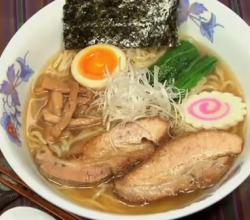
Ramen
Image Credit: ifood.tv
 - the curly type pasta, that many are familiar with, but before living here, I had never eaten fresh ramen.  It is the perfect cure to a cold day or a monster hangover.  Unfortunately, our favorite little ramen shop on island closed down unexpectedly, but ramen can be found all over Japan and in many restaurants.  There's even a Cup Noodle Museum in Osaka, you can learn more about this meal in a cup, decorate your own cup and make one with the fillings of your own choice, if you are interested.
Image Credit: www.sitsam.com

Soba
Soba bundles
 - buckwheat noodles.  These are thin light brown straight noodles. In the grocery store, they in packages of cute serving size bundles.  Soba is served both hot or cold.  One of my favorite preparations, although not Japanese, is this cold mango salad with soba noodles:
Beautiful meal made by Gabe Evans, Int'l Food Tech Teacher Conference 2013.


Udon
Shrimp Tempura Udon -
Image Credit: www.asianfoodgrocer.com
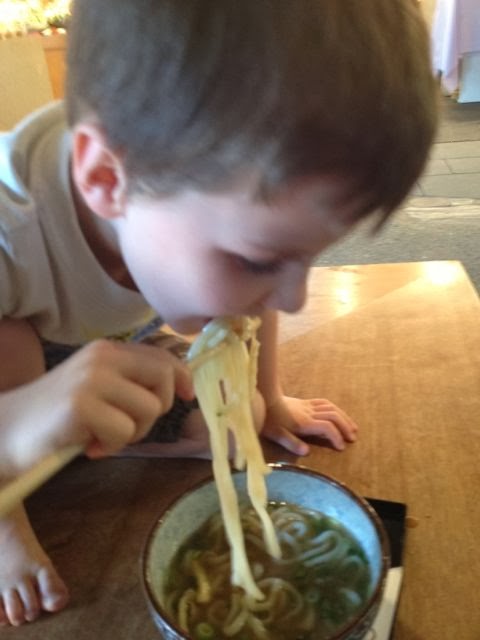
Udon are fat noodles, usually eaten in a hot soup. There are many variations of this.  My personal favorite is putting in udon at the end of a nabe hot pot.

With the weather turning cooler, I'm sure we'll be eating at least one of these different types of noodles while you are here.  This is an easy meal to grab out and about.

Saturday, October 05, 2013

30 Things You Should Know and/or Will Love about Japan Series: # 17

#17 Fall Foliage Report


In Japan, nature rules.  

All forms of design - cuisine, food, textiles, and decor are influenced by nature. In Japan, people take time to appreciate nature around them - from Moon Viewing, to viewing the Fall foliage to picnicking under the cherry blossoms every spring.


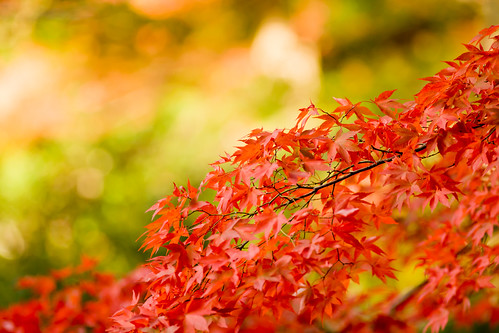
Fortunately, October/November is one of the best times to visit Japan.  The leaves are changing and the air is getting cool.  My favorite leaves this time of year are the ginko:

Photo Credit: artolog via Compfight cc

and the Japanese maple:


The only drawback to spending time under the leaves (or any other tourist attraction), is that often there are A LOT of other people also enjoying the fresh air and beautiful scenery with you.

One thing we have never seen before (which doesn't mean that this doesn't exist) are forecasts for Spring blooms and Fall foliage.  People know exactly when to travel, hike or plan a picnic with their co-workers.  It is serious business.

Here's a link to the Japan 2013 Fall Foliage Map and a website on the best places to enjoy the leaves.  We will definitely be going to Hiroshima, Miyajima, Kyoto and Arashiyama, which will be great places to see the leaves.  We are also thinking about going to Koyosan.  We have never been there before and the foliage forecast says it will be at the peak during your visit.